
Many small businesses in Morocco run everything from an Instagram page, a Facebook page and a WhatsApp number. It works, up to a point. Customers find you through friends, see your photos and send a message. So why spend money on a website?
Because a large share of your future customers never open Instagram to look for you. They type into Google. This article looks at the numbers, explains what a website does that a social page cannot, and ends with a short list of what your site needs at minimum, whoever builds it.
How people in Morocco go online in 2026#
Morocco is now a very connected country. According to DataReportal’s Digital 2026 Morocco report, there were 35.5 million internet users at the end of 2025, out of a population of 38.5 million.
92.2%
of people in Morocco use the internet: 35.5 million users at the end of 2025.
Source: DataReportal, Digital 2026: Morocco (data for end of 2025)
The national regulator says the same thing in its own terms. The ANRT counted internet subscriptions (fixed and mobile) equal to 112.59% of the population at the end of December 2025, up from 109.21% a year earlier, as reported by Finances News Hebdo. Above 100% simply means many people have more than one subscription, for example a phone plan and a home connection.
Social media is big, but it is not everyone#
The same DataReportal report counts 22.8 million social media user identities in Morocco, or 59.1% of the population. By platform, the advertising tools of each company give these potential audiences at the end of 2025:
| Platform | Ad reach in Morocco | Share of population |
|---|---|---|
| 22.8 million | 59.1% | |
| YouTube | 21.6 million | 56.1% |
| 15.1 million | 39.2% | |
| TikTok | 16.7 million (adults 18+) | 62.3% of adults |
Source: DataReportal, Digital 2026: Morocco. Ad reach is the audience a platform lets advertisers target; it is not the same as active users.
Instagram, where many cafés, boutiques and riads put most of their effort, reaches about four in ten people in Morocco. That is a lot of people, but it is far from the 92% who are online.
And when they search, they use Google#
96.14%
of web searches in Morocco go through Google. Bing is second with 2.73%.
Source: StatCounter, search engine market share in Morocco, October 2026
When someone in Rabat types “dentist Agdal”, or a visitor in Paris types “riad Marrakech medina with pool”, the answer comes from Google: the map with nearby businesses, the reviews, and a list of websites. Your Instagram page can appear there, but it rarely ranks well for these searches, and it gives Google little to work with: no clear address page, no opening hours in a format it can read, no page per service.
What a website does that a social page cannot#
1. It makes you findable on Google Search and Google Maps#
Social media is a feed: people see you when the algorithm decides, mostly people who already follow you. Search works the other way: the customer has a need right now and is looking for someone to solve it. A website with clear pages (“Our rooms”, “Menu”, “Admissions 2026-2027”, “Teeth whitening in Casablanca”) gives Google something to show for each of those searches.
Paired with a Google Business Profile, your website also helps you on Google Maps, which is where people choose a restaurant or a pharmacy when they are already in the street.
2. It builds trust before the first message#
Before booking a room, enrolling a child or seeing a doctor, people check. A clear website with your address, prices or price ranges, photos of the real place and a way to contact you answers their questions before they ask. For a clinic or a private school, a page that looks official carries more weight than an Instagram grid, especially for parents and older patients.
3. You own it#
Your Instagram followers belong to your account, and your account belongs to Meta. Accounts get hacked, restricted or disabled, sometimes by mistake, and appeals can take weeks. Algorithm changes can also cut your reach overnight. A website on your own domain (yourbusiness.ma or .com) stays yours. So does the list of customers who booked or wrote to you through it.
4. It takes bookings and requests while you sleep#
On Instagram, every booking is a conversation: “Is it available on Saturday?”, “How much?”, “Where are you?”. A simple booking or appointment form collects the date, the number of people and the phone number in one go, and sends you a clean request. You still confirm by WhatsApp if you like, but you start with the right information.
5. It works for visitors from abroad#
19.8 million
tourist arrivals in Morocco in 2025, up 14% on 2024, according to the Ministry of Tourism.
Source: Ministry of Tourism, via Libération / AllAfrica (2025 figure)
Most of these visitors plan their trip from home, on Google, in their own language. A riad, a restaurant in the medina or a surf school that has a French and English website can be found and booked before the traveller lands. One that exists only on Instagram depends on the visitor already knowing its name.
Social media, WhatsApp and website: how they work together#
This is not a choice between the three. Each one does a different job:
- Instagram, Facebook, TikTok: show what is new, build a following, reach people who were not looking for you yet.
- Google and your website: catch people who are actively looking, and give them the full information.
- WhatsApp: close the deal, answer the last question, confirm the booking.
The website sits in the middle. Your Instagram bio links to it. Your Google Business Profile links to it. The website has a WhatsApp button on every page. The customer can move between them without losing you.
Examples by sector#
A riad in Marrakech or Fès#
Guests search “riad with rooftop Marrakech” or “riad Fès medina” months ahead. A website with one page per room, real photos, a map to find the door in the medina and a booking request form lets you take direct bookings without paying a platform commission on every night. Keep Booking.com or Airbnb if they bring you guests; the website gives you a second channel you control.
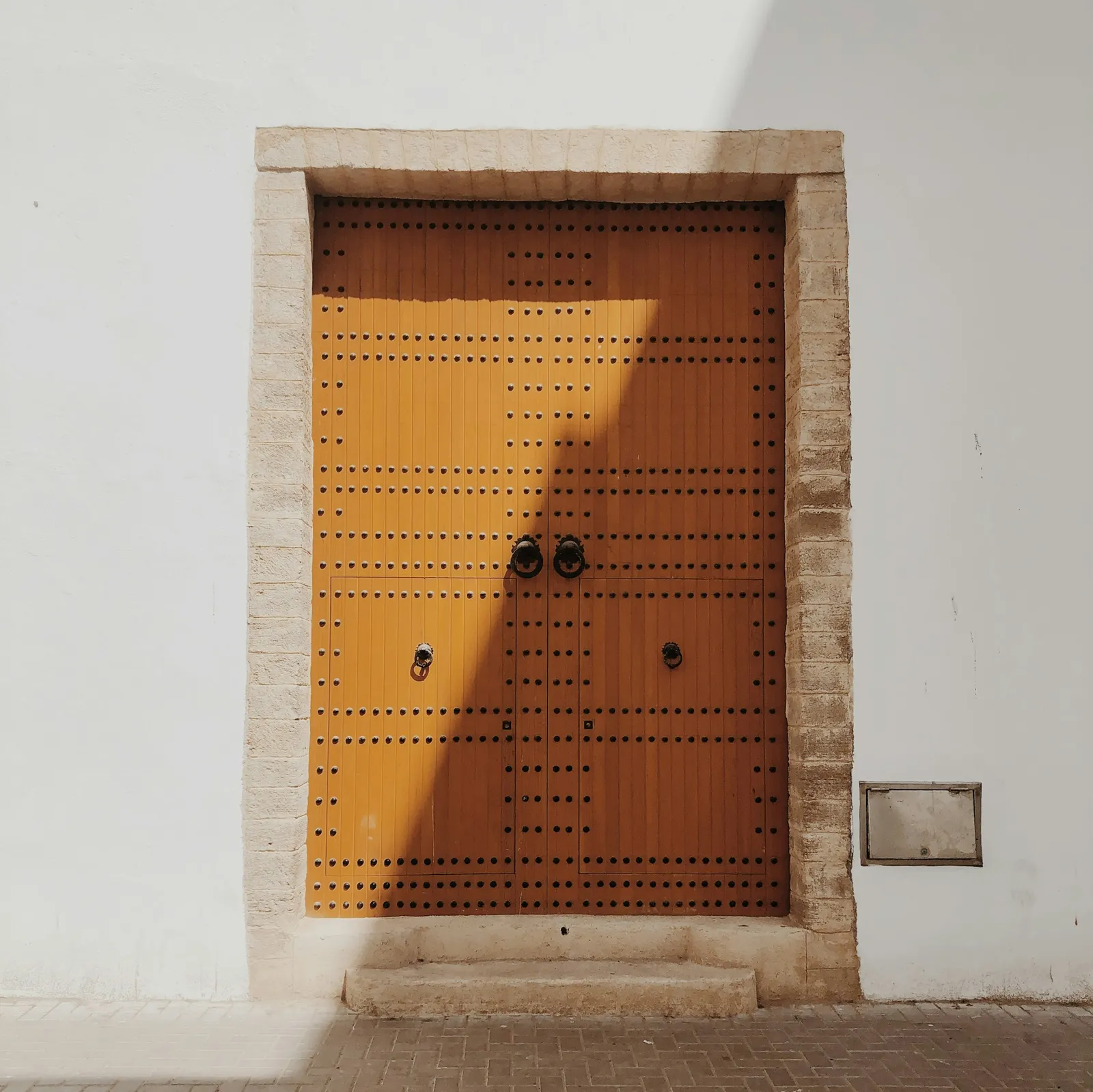 From the lane, many riads are just a door with no sign or number. A map on your website gets guests to the right one.
A restaurant or café#
People decide where to eat on Google Maps: rating, distance, photos, menu. A website with the menu as text (not only a photo), opening hours, a table booking form and a link to your delivery apps answers the three questions everyone asks: what do you serve, how much, and are you open now?
A clinic or medical practice#
Patients search for a specialty and a neighbourhood: “pédiatre Maârif”, “kiné Hay Riad”. A site with a page per service, the doctors’ names and specialties, opening hours and an appointment form gives Google the information to show you, and gives the patient confidence. Keep medical information factual and follow the rules of your professional order.
A private school#
Parents compare schools for weeks before enrolling. They look for programmes, fees or fee ranges, transport, the admission calendar and photos of the premises. A website with an admissions page and a pre-registration form gives them a place to find it all, and gives you a list of interested families instead of the same questions in fifty WhatsApp chats.
What your website needs at minimum#
Whatever your budget and whoever builds it, check these points:
- Your own domain name (.ma or .com), not a free subdomain.
- Fast and readable on a phone. Test it yourself on mobile data.
- Name, address, phone and opening hours, as text, the same as on Google.
- A Google Maps location embedded on the contact page.
- A WhatsApp button and a call button visible on every page.
- A booking, appointment or request form that sends you the details.
- Real photos of your place, your team, your products.
- French and, if you have foreign customers, English. Arabic if your customers expect it.
- One page per main service or offer, with a clear title. This is what Google matches to searches.
- Connected to Google Search Console and your Google Business Profile, so you can see how people find you.
If your current site, or the one you are planning, covers these ten points, you are ahead of many businesses around you.
Frequently asked questions#
Is a Facebook page enough for a small business in Morocco?#
It is a good start, but not enough on its own. Around 96% of searches in Morocco go through Google, and a Facebook page rarely ranks for searches such as “restaurant near me” or “clinic in Casablanca”. A website, combined with a Google Business Profile, covers that part.
How much does a website cost for a small business in Morocco?#
It depends on the scope. A one-page site with a booking form costs much less than a multi-page site with a booking dashboard or an online shop. Ask for a written scope that lists pages, languages and features, and check whether domain and hosting are included.
Do I need a website if I already get customers on WhatsApp?#
WhatsApp is where conversations happen, not where new customers find you. A website brings people from Google to your WhatsApp with the right information already in hand.
How long does it take to appear on Google?#
Your Google Business Profile can appear within days once verified. For a new website, expect several weeks before Google indexes and ranks your pages, faster if the site is well structured and registered in Search Console.
Sources#
- DataReportal, Digital 2026: Morocco: internet users, population, social media identities and platform ad reach (data for late 2025).
- StatCounter, Search engine market share in Morocco (October 2026).
- ANRT figures for end of December 2025, reported by Finances News Hebdo (16 March 2026).
- Ministry of Tourism, 2025 arrivals, reported by Libération via AllAfrica (7 January 2026).